
Blog Details
- Member
- March 5, 2026
Discussion Roadmap for 5× Expansion of Inbound Medical Wellness and Health Tourism
Srijan Sanchar Discussion Paper
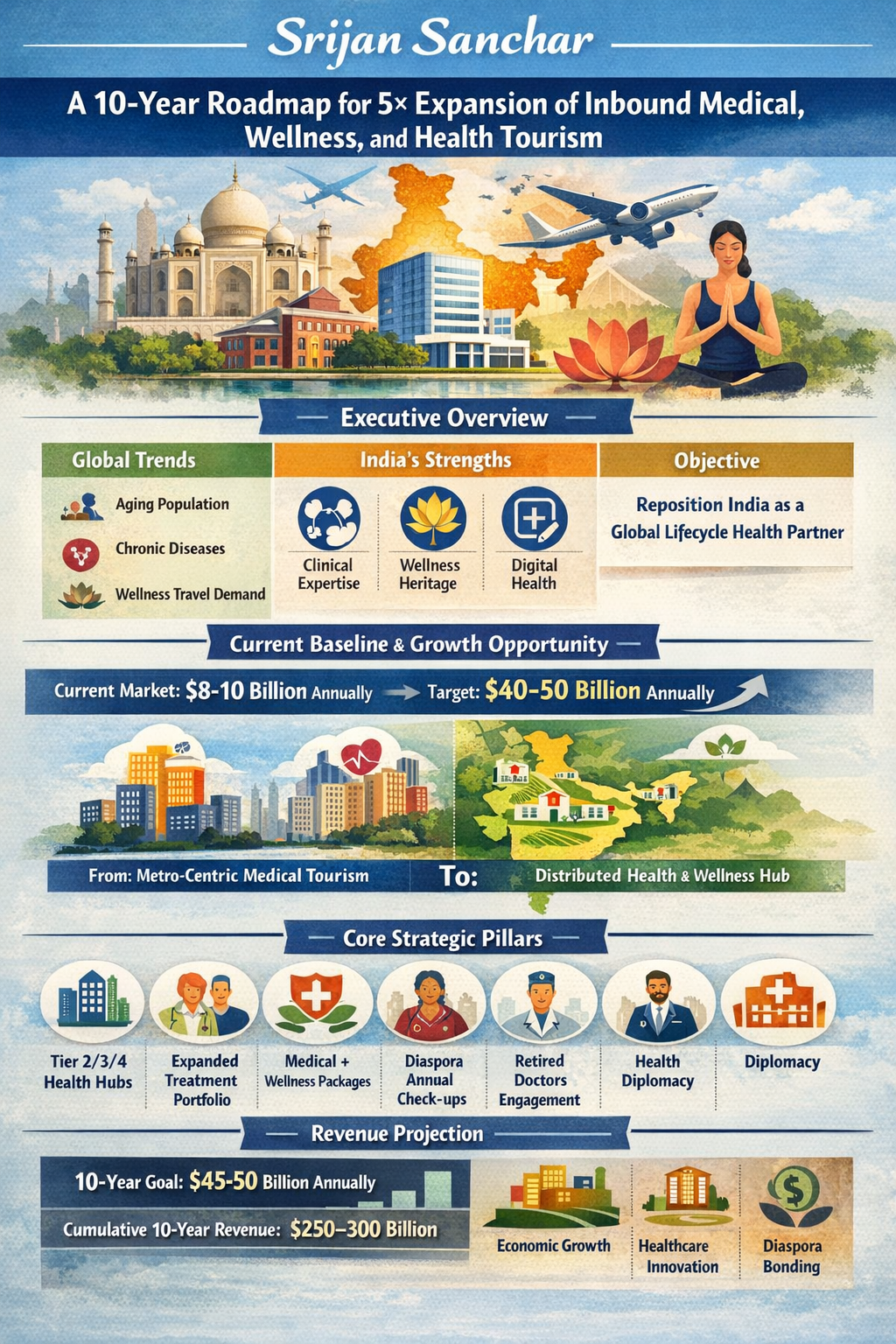
A 10-Year Roadmap for 5× Expansion of Inbound Medical, Wellness, and Health Tourism
Executive Overview
stands at a strategic inflection point in global healthcare mobility. Rising chronic disease burdens, aging populations, post-pandemic health awareness, and increasing demand for preventive and wellness-oriented care have reshaped global health travel flows. India possesses clinical depth, cost competitiveness, a strong English-speaking medical workforce, established pharmaceutical manufacturing capacity, digital health infrastructure, and civilizational wellness systems such as Ayurveda and Yoga.
The opportunity is not merely to expand patient inflows, but to reposition India as a global lifecycle health partner integrating medical excellence, preventive care, wellness science, digital health, and health diplomacy. This discussion paper outlines a structured roadmap to achieve a fivefold expansion in inbound medical, wellness, and health tourism over the next decade, while deepening qualitative impact and distributing benefits across Tier 2, 3, and 4 cities.
Strategic Vision
The transformation requires moving from:
- A metro-centric, surgery-dominant medical tourism model
to - A distributed, preventive, wellness-integrated, diplomatically anchored health ecosystem.
The strategic ambition is to evolve India into a Global Health and Wellness Hub that:
- Delivers high-quality specialized medical care
- Integrates conventional and traditional systems
- Institutionalizes preventive annual health pathways
- Leverages diaspora engagement
- Strengthens bilateral health partnerships
- Activates underutilized capacity in emerging urban centers
Current Baseline and Growth Opportunity
India’s inbound medical tourism sector is estimated to generate approximately USD 8–10 billion annually (including direct medical expenditure, hospitality, logistics, and ancillary services). Growth has historically been driven by cardiac surgery, oncology, orthopedics, transplant medicine, and fertility services, largely concentrated in major metropolitan centers.
Global trends suggest strong tailwinds:
- Rapid growth in cross-border care demand from Africa, the Middle East, South Asia, and parts of Europe.
- Increasing demand for affordable chronic disease management.
- Rising global interest in preventive diagnostics and wellness retreats.
- Aging diaspora populations seeking culturally aligned healthcare.
If structurally expanded and strategically repositioned, the sector can realistically scale to USD 40–50 billion annually within 10 years, representing a fivefold increase in value and higher qualitative depth.
Core Strategic Pillars
1. Distributed National Health Hub Network
To reduce overconcentration in metropolitan cities, India must systematically upgrade 50 Tier 2, 3, and 4 cities as specialized health clusters.
Each city can be aligned with focused capabilities such as:
- Oncology and radiation therapy
- Orthopedics and rehabilitation
- Geriatric and chronic disease management
- Fertility and reproductive medicine
- Mental health and neuro-care
- Regenerative and longevity medicine
Upgrading accreditation, ensuring international quality benchmarks, and developing digital integration will enable these cities to attract global patients while stimulating regional economic growth.
A distributed model increases resilience, reduces cost pressure in metros, and improves patient experience.
2. Expansion of Treatment Portfolio
The next decade must broaden India’s offerings beyond surgical interventions into lifecycle health solutions:
- Preventive full-body diagnostic programs
- Chronic disease reversal programs
- Geriatric care ecosystems
- Regenerative medicine and cell therapies
- Integrative oncology combining conventional and supportive care
- Mental health and wellness programs
- Fertility preservation and advanced reproductive technologies
- AI-assisted precision diagnostics
This diversification increases patient lifetime value and encourages repeat visitation.
3. Integration of Medical and Wellness Tourism
Global demand is shifting toward holistic care. India’s wellness assets can be integrated into structured medical pathways:
- Pre-surgical conditioning programs
- Post-operative recovery retreats
- Chronic disease lifestyle reset packages
- Detox and preventive health residencies
- Corporate executive health programs
This approach increases qualitative positioning and extends average patient stay duration, multiplying economic impact across hospitality, transport, and local services.
4. Annual Health Check Program for the Global Indian Diaspora
The Indian diaspora represents a uniquely powerful recurring engagement opportunity.
A structured “Global Indian Annual Health Pass” can offer:
- Comprehensive diagnostic screening packages
- Digital pre-assessment and tele-consultation
- Family-linked health planning
- Incentivized repeat visitation
- Longitudinal digital record tracking
Even if 5–8 percent of the global diaspora participates annually, it could generate USD 5–8 billion in additional annual inflow by Year 10 while strengthening long-term national engagement.
5. Re-engagement of Retired Doctors of Indian Origin
A Global Indian Medical Advisory Fellowship can invite retired or semi-retired doctors of Indian origin to:
- Serve as visiting consultants
- Mentor emerging Tier 2 and 3 institutions
- Assist in accreditation alignment
- Participate in tele-mentorship
- Act as international health ambassadors
This enhances credibility, transfers global best practices, and builds trust corridors with foreign healthcare systems.
6. Health Diplomacy Integration
Health tourism must be embedded within India’s diplomatic and trade strategy. Key measures include:
- Fast-track medical visas
- Bilateral health service agreements
- Insurance portability arrangements
- Regional health corridors
- Structured partnerships with Africa, ASEAN, Middle East, and South Asia
- Development assistance linked to medical training and telemedicine
Health becomes an instrument of soft power, trust-building, and strategic influence.
7. Digital Backbone and Continuity of Care
Digital health integration ensures seamless pre-arrival, in-country, and post-return continuity:
- AI triage and second-opinion platforms
- Secure cross-border digital records
- Remote follow-up monitoring
- Tele-rehabilitation and chronic care management
Digital trust enhances repeat visits and long-term patient relationships.
Revenue Projection: 10-Year Outlook
Assumptions
- Current baseline: USD 9 billion (midpoint estimate)
- Compound annual growth rate under enhanced strategy: 16–18%
- Expansion into wellness, preventive, and diaspora segments increases average revenue per visitor
- Tier 2–4 city activation expands capacity by 60–80%
- Diplomatic corridors increase inflow stability
Projected Annual Revenue
| Year | Estimated Annual Revenue (USD Billion) |
|---|---|
| Year 1 | 10 |
| Year 3 | 15–17 |
| Year 5 | 22–25 |
| Year 7 | 32–35 |
| Year 10 | 45–50 |
Cumulative 10-Year Revenue
Over a decade, cumulative inflow could reach approximately USD 250–300 billion, including direct and indirect economic effects.
This includes:
- Hospital revenue
- Hospitality and tourism spending
- Diagnostics and pharmaceutical sales
- Wellness and retreat services
- Transport and ancillary sectors
Multiplier effects across Tier 2 and 3 economies could substantially boost local employment and infrastructure development.
Qualitative Gains Beyond Revenue
- Regional economic diversification
- Medical education enhancement
- Technology transfer and innovation acceleration
- Soft power strengthening
- Increased diaspora integration
- Improved global healthcare credibility
Risk Considerations
- Quality inconsistency across cities
- Over-commercialization
- Domestic healthcare displacement concerns
- Regulatory bottlenecks
- Global competition from Southeast Asia and Eastern Europe
Mitigation requires strong accreditation enforcement, transparent pricing, ethical safeguards, and synchronized policy coordination.
Conclusion
The opportunity is not incremental expansion but structural transformation. By integrating distributed health infrastructure, preventive programs, wellness science, diaspora engagement, and diplomatic strategy, India can reposition itself as a global lifecycle health partner.
A disciplined, coordinated approach can realistically achieve a fivefold expansion in inbound medical, wellness, and health tourism within a decade, generating USD 45–50 billion annually and up to USD 300 billion cumulatively over ten years.
The strategic payoff extends beyond revenue. It strengthens national resilience, enhances global influence, and activates underutilized regional capacity.
This transformation, if pursued coherently, can make health not merely a service sector, but a cornerstone of national development and global engagement.
Srijan Sanchar
Discussion Paper
Global Health, Wellness & Diplomacy Initiative